
Last updated: 25 July 2026 · ~6 min read · By the Imbas editorial team
TL;DR: A moisturiser for eczema is judged on the back label, because it stays on your skin all day. A moisturiser is the one product you don’t rinse off, so its ingredient list carries more weight than any other in your routine. For eczema-prone skin, check the same short list — added fragrance (Parfum), the preservative MI, and oxidised Linalool/Limonene — but read it a notch more carefully than you would a cleanser, because a leave-on gives every ingredient all day to matter. A cream that reads well is fragrance-free (not just “unscented”), free of isothiazolinones, and built on a simple barrier base like glycerin, ceramides, or petrolatum. Most creams pass.
Ask any dermatologist about eczema and the first advice is usually the least glamorous: moisturise, and keep moisturising [AAD, aad.org]. Which makes the moisturiser aisle a strange experience, because the products built for exactly this job — “soothing,” “for dry, sensitive skin” — carry the same unregulated front-of-bottle words as everything else. The real information is on the back.
As always, most of what’s on a moisturiser label is completely fine, including for eczema-prone skin. Here’s the short list that isn’t automatic, and the calm way to read the rest.
Why does a moisturiser label matter more than a cleanser’s?
Quick Answer: Because you don’t rinse it off. A cleanser touches skin for about thirty seconds; a moisturiser stays there all day, often under clothes in Malaysian heat. The same ingredient can be a non-issue in a wash and worth a second look in a cream — and even regulators treat the two categories differently.
Call it the leave-on rule: contact time, not the ingredient alone, sets the stakes. Europe’s cosmetic rules — the strictest widely used benchmark — often set different limits for the same ingredient depending on whether a product washes off or stays on. The clearest example is the preservative methylisothiazolinone (MI): after years of rising allergy reports it was banned in leave-on cosmetics [Reg. (EU) 2016/1198] while remaining permitted but restricted in rinse-off products at a low limit [Reg. (EU) 2017/1224; SCCS/1521/13]. Same molecule, different rules, because the exposure is different.
Key takeaway: An ingredient list that’s low-stakes on a body wash deserves a slightly closer read on a cream.
Which ingredients are worth a second look in a leave-on?
Quick Answer: The same three as always — fragrance, MI, and oxidised Linalool/Limonene — but in a leave-on you’re giving them all day to matter. Presence isn’t proof, and none of these are “toxic.” They’re simply the ingredients that turn up most in allergy testing of sensitive skin.
The same flagged ingredients, read for a leave-on cream vs a rinse-off wash. Regulatory status per EU Cosmetics Regulation annexes and SCCS/1521/13; allergy-frequency framing per NACDG patch-test data (people tested for allergies, not the general public). Retrieved July 2026.
| Ingredient (INCI) | In a rinse-off (cleanser) | In a leave-on (moisturiser) |
|---|---|---|
| Parfum / Fragrance | Worth noticing | The first thing to check — and the most common surprise in “soothing” creams |
| Methylisothiazolinone (MI) | Permitted within limits [Reg. (EU) 2017/1224] | Not permitted in EU leave-on products [Reg. (EU) 2016/1198] — a genuinely useful flag if a cream lists it |
| Linalool / Limonene | Age-dependent | Same, and a cream you’ve had open a year is exactly where oxidation matters |
If a leave-on cream on a Malaysian shelf lists MI, that’s worth stating precisely rather than dramatically: the EU no longer permits this ingredient in this product type. Stock here arrives from many markets and eras, so it happens.
Key takeaway: Read a cream’s fragrance and preservative lines with a little more attention than a wash’s. That’s the whole adjustment.
Which moisturiser ingredients get an undeserved bad reputation?
Quick Answer: Lanolin, propylene glycol, and — the big one — petrolatum and mineral oil. The “clean beauty” internet is hardest on exactly the ingredients that make moisturisers work, and the evidence mostly doesn’t cooperate.
- Lanolin. The classic villain of avoid-lists, yet general-population patch-test positivity is around 1.6%, and dermatologists openly debate whether many positive tests matter clinically [PMC11355248]. For most people it’s simply a good occlusive.
- Propylene glycol. On every “avoid” list; reacts in a small minority, and the test itself over-flags it [NACDG — around 3.5% among patch-test patients, low clinical relevance]. If you know you’re PG-reactive, avoid it. If you don’t, it’s very unlikely to be your problem.
- Petrolatum and mineral oil. Feared for sounding industrial. In cosmetic-grade form they’re among the most widely used barrier ingredients in dermatology, including in the creams most often recommended for eczema. “Sounds like a chemical” is not a skin reaction.
If a chart or app flags all of these red, it’s optimising for alarm, not accuracy. A useful flag is a rare one. We unpack more of these in the ingredients you can stop worrying about.
Key takeaway: The ingredients that sound scariest are often the ones doing the repairing.
What does a good moisturiser for eczema look like?
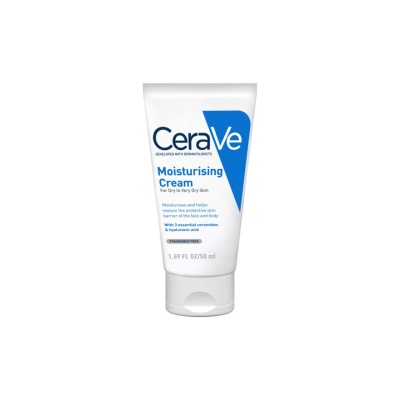
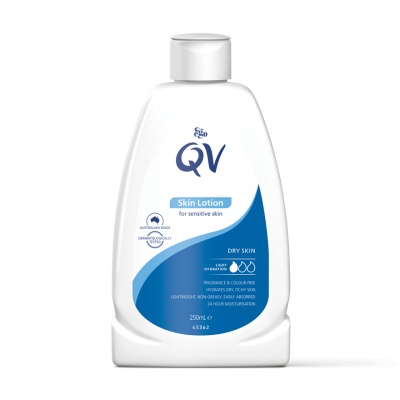
Quick Answer: Fragrance-free (the word Parfum absent, not just “unscented”), no isothiazolinones (this is a leave-on), and a simple, barrier-first base — glycerin, ceramides, petrolatum, and dimethicone are all good signs, not warnings. A few widely available options read clean against those criteria on their published formulas: CeraVe Moisturizing Cream (ceramides plus petrolatum, fragrance-free) and QV Skin Lotion (fragrance-, lanolin- and PG-free, which is handy if you’re genuinely PG-reactive).
The same label trap applies as everywhere: “unscented” is not “fragrance-free.” Unscented can mean a masking fragrance was added to cover a raw-material smell; fragrance-free means none was added. Read for “fragrance-free” and confirm it on the INCI list.
One honest caveat, because it undercuts our own suggestion in a way worth stating: formulas change per market and over time, and a “Baby” or regional version of the same brand sometimes differs from the one we checked. Confirm the ingredient list on the specific pack you’re buying. That’s exactly the check Imbas does in a couple of seconds.
The same label-reading approach applies to the wash you use first — here it is for cleansers.
Key takeaway: Buy for a fragrance-free, barrier-first formula confirmed on the back, not “soothing” printed on the front.
Frequently asked questions
What is the best moisturiser for eczema-prone skin? There’s no single winner, but the criteria are clear: fragrance-free (not “unscented”), no isothiazolinones, and a barrier-first base with ingredients like ceramides, glycerin, or petrolatum. A plain cream that meets those often outperforms a pricier one marketed for eczema that still contains added fragrance. Confirm the INCI list on the pack you actually buy.
Is petrolatum or mineral oil bad for eczema? No. In cosmetic-grade form, petrolatum is one of the most widely used and well-tolerated barrier ingredients in dermatology, common in creams recommended for eczema. It works by sealing in water rather than reacting with skin. The industrial-sounding name is not a reason to avoid it.
Why does MI matter more in a moisturiser than a cleanser? Because a moisturiser stays on your skin all day while a cleanser rinses off in seconds. The EU reflects this: methylisothiazolinone is banned in leave-on products but permitted within limits in rinse-off ones [Reg. (EU) 2016/1198; 2017/1224]. A cream listing MI is a more meaningful flag than a wash listing it.
Can I use body moisturiser on my face if I have eczema? Often yes, if the ingredient list is simple and fragrance-free — the label matters more than the “face” or “body” label. Facial skin is thinner, so avoid heavy actives or added fragrance, but a plain barrier cream that suits eczema-prone body skin is usually fine on the face too.
Is fragrance-free moisturiser really necessary? For eczema-prone skin, it’s the single highest-value choice. Fragrance is the most common thing sensitive skin reacts to, and a “soothing” cream that lists Parfum high up is a common surprise. Going fragrance-free removes the most likely irritant in one step, at no cost to how well the cream moisturises.
How often should I moisturise eczema-prone skin? Dermatology guidance centres on regular, generous moisturising, typically at least twice a day and after bathing while skin is still damp [AAD, aad.org]. Consistency matters more than the specific product — the best cream is the one whose label suits you and that you’ll actually reapply.
Moisturisers that read cleanly for eczema-prone skin
Most moisturisers are fine. These are two whose labels read cleanly for a leave-on you keep on all day — and here’s why we’d reach for each.
Some links are affiliate links — if you buy through them we may earn a small commission, at no extra cost to you. We only suggest products that meet the criteria described in the article, and we say why.
Prices and availability change, and formulas differ by market. General information, not medical advice — for persistent or severe symptoms, see a doctor or dermatologist. Imbas is launching soon — join the waitlist →
A moisturiser can only do so much if the cleanse before it is stripping your skin — the other half of the routine is here → Gentle cleansers for eczema-prone skin.
Or — scan the one on your shelf
The tube you already own is probably fine. Point Imbas at its ingredient list, tell it your skin is eczema-prone, and it tells you plainly if anything is genuinely worth knowing — and reassures you about the rest. Imbas is launching soon — join the waitlist →
This is general information, not medical advice — if your eczema is severe or persistent, see a doctor or dermatologist. Some links may be affiliate links; we only suggest products that meet the criteria above, and we say why.